

|
|
   |
Back to the boatLindsay McRoryNovember 3, 1995
Normally, packing is putting things in boxes to go from one place to another. In our case we had three destinations: some stuff to the boat, some in storage, and some to stay. It's sort of like three-dimensional packing. We already had all our bedding, cooking gear, and some clothes stowed on board Hakuna Matata. This kept our final load to eight duffel bags, four of which were old enough or cheap enough to be considered "disposable." The others, once unpacked, would be stuffed tightly into some far corner of the boat until some far-off time when they'd be needed again. Usually, this kind of storage means they'll come out covered in mildew with a topping of bad-foot odor. We decided to keep only a few bags for the occasional visit home. I was the biggest luggage hog, mostly because I plan to be working on the water, which requires an amazing amount of reference books and related material. Although more and more titles are available on CD-ROM, others like "Numerical Recipes in C" or "System Performance Modeling" aren't quite that mainstream. The only last-minute glitches we had involved life insurance. We've all seen the commercials with a small sailboat anchored in some tropical paradise with the perfect couple on board. Then we see the insurance pitch. But actually insurance companies don't want you to do it--just dream about it while you give them your money. I have always been a most-insurable person: never smoked, never sick, always had hefty policies. But once we started to arrange for new term-life policies to cover us during the extended cruise, no one would even quote us. At least they could have quoted some outrageous amount so we could laugh and hang up. Two brokers chased a number of insurance companies and could not stir up enough interest to get as far as a blood test. Underwriters must lead incredibly sheltered lives. We will try out some U.S. insurance companies to see of they have a broader outlook. The flights from Canada to Virginia were uneventful. Kita and Wesley are little road warriors now. They have more frequent-flyer miles than most adults I know. We landed in Norfolk, Virginia, in the early evening during a downpour ... not a good omen. After some fast unloading we tried to get settled down--but what was that smell? We checked the fridge, the freezer, and a few lockers, but found nothing. And this smell was bad. I had visions of a large rat body decomposing in some inaccessible section of the hull. The mystery odor remained unsolved, and we went to bed. During the night the bilge pump turned itself on a couple of times. Loose stuffing box, I thought, and rolled back over with plans to check it in the morning. Some background might be in order. Marine toilets, otherwise known as
heads, dump wastewater overboard or into a holding tank. Canada and the
United States have laws about where you can and can't dump sewage.
Hakuna Matata, like most offshore boats, uses a dual system. A
40-gallon holding tank stores waste until pumped out at a station. When
offshore, we can switch to overboard. We are very diligent about following
the rules regarding overboard discharge. In popular harbors it would be
pretty disgusting to think that every boat was pumping raw sewage into an
otherwise beautiful spot. The smell? The holding tank had developed a split along the bottom corner and was oozing 25 gallons of 30-day old crap through the bottom of the boat and into the bilge. I always say a bad day on the boat is better than a good day at the office, but I never envisioned this. The only thing I could think of was all the different names we have for what we put in the toilet, sewage, effluent, black water, the odd cotton bunny. But a rose by any other name ... |
 
 |
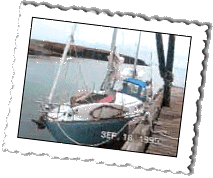 (Editor's Note: Lindsay and Denise McRory, along with
their children Kita and Wesley, have returned to the Hakuna Matata
waiting in Norfolk, Virginia. After months of preparation--a lifetime,
really--they boarded the boat on November 1 to begin their great
voyage.)
(Editor's Note: Lindsay and Denise McRory, along with
their children Kita and Wesley, have returned to the Hakuna Matata
waiting in Norfolk, Virginia. After months of preparation--a lifetime,
really--they boarded the boat on November 1 to begin their great
voyage.)

