A final checklist of emergency gearLindsay
McRory
October 28, 1995
 (Editor's Note: Lindsay has delivered the Hakuna
Matata from Halifax, Nova Scotia to Norfolk, Virginia. He is now back
in Canada to gather the rest of his family together and return to the boat
for a November 1 departure.) (Editor's Note: Lindsay has delivered the Hakuna
Matata from Halifax, Nova Scotia to Norfolk, Virginia. He is now back
in Canada to gather the rest of his family together and return to the boat
for a November 1 departure.)
As we make final preparations for departure, it's a good time to review
some of the basic safety gear that will help the Hakuna Matata deal
with most common emergencies you would expect to encounter at sea.
In addition to basic first-aid, communications, and navigational
equipment, we have:
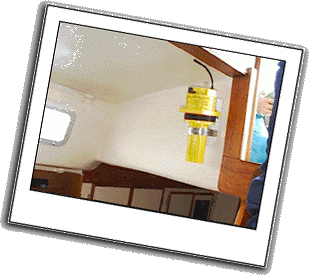
Alden 406 MHz Emergency Positioning Radio Beacon (EPIRB)
An
EPIRB, as it is commonly called, is an Emergency Positioning Radio Beacon.
The 406 is the radio frequency at which the unit operates. You manually
activate the unit. It then transmits the name and position of your boat to
numerous orbiting satellites. The satellites then relay the information to
the nearest Coast Guard or search-and-rescue facility. That's the sales
story anyway.
Each 406 MHz EPIRB has a unique serial number that it transmits when
activated. A new unit is registered to your name and vessel by the company
that sells the unit, and by the new owner. At any time, there are at least
four active satellites orbiting to receive transmissions from distress
beacons. The satellites (which orbit the earth every 106 minutes) are in
low orbit and consequently have only a limited "view" of the earth.
According to the manufacturer, the elapsed time between activation and the
reception of a signal can vary from a few minutes to a few hours,
depending on your location.
We mounted Hakuna Matata's EPIRB on the bulkhead for easy access
from the cockpit or the cabin.
Dunlop Beaufort six-person life raft
We went with a
commercial-quality raft. It is easier to get into, a little stronger, more
expensive, and much bigger than a six-person yacht life raft. Packed
inside the raft are emergency rations of water and food, fishing gear, a
flash light, glow sticks, flares, a compass, buckets, and an EPIRB.
Many people buy a life raft without ever actually knowing what's
inside. I was lucky enough to live close to the dealer and watched as the
raft was tested and packed.
Lifesling
The lifesling is our primary man-overboard
recovery system. Inside the package is a floating sling attached to a
floating line. There is a block-and-tackle system that attaches to the
mizzen boom for hauling the victim out of the water.
 
Jack lines
Jack lines are used at
night or during rough weather to prevent people from falling overboard.
During these times, anyone above deck wears a chest harness. A short line
from the chest harness clips to a rope called a jack line. Once clipped
in, you can walk all the way to the bow without unclipping. Hakuna
Matata uses half-inch climbers webbing for jack lines. The flat
webbing will not roll out from under your feet--not a fun way to fall
overboard--while you move about the deck.
You must have one hell of a wife.
Yup.
|