

|
|
   |
Looking southLindsay McRorySeptember 23, 1996
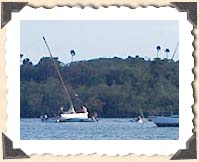
We will probably be in Salinas for Christmas. After that, who can say? We may island hop down to Venezuela, or we may go straight to Venezuela and follow the islands back up. We've heard arguments from experienced sailors about the relative merits of each route. Every sailor has his or her individual views about sailing and the use of their engine. The purist sailor will only start the auxiliary motor for docking and recharging the batteries. Some motor sailors may not raise a sail for years. Other sailors believe the act of sailing into an anchorage and dropping anchor under sail alone is an accomplishment fit for an "atta-boy" medal. It is difficult to do and should be practiced. Unless you are practicing in a familiar location, it's a skill I save for a day when it's required. Most anchorages are poorly charted, sometimes crowded. Outside the United States the buoys are always dubious, and cannot be trusted. You can witness people sailing on and sailing off anchors frequently in Georgetown, Bahamas. It's the place where looking good to fellow yachties is the thing to do, kind of the Aspen, Colorado, of sailing destinations. And twice since we've been in Luperon, boats have attempted to sail into the harbor and put on a show. The crews on both boats were busier looking around at the other boats--to see who was watching. They both ran aground. The 15 knots of trade winds blowing behind them helped push the boat deep into the soft mud. Yesterday's grounding was entertaining, but not in the way intended. The kids noticed a boat coming into the harbor and thought it was Gaucho, a boat that was here earlier with kids aboard. The new boat managed the first set of buoys, moving fast under full main. We were all on deck looking. Three people aboard the incoming boat were standing there, looking at us. We waved. They waved. They waved at some other boats. Unfortunately, they didn't see the next starboard-side marker or the nearly dry bank in front of them. Seconds later, their stern rose quickly and gracefully as their keel drove deep into a mud bank. The mainsail, trimmed for a broad reach, was still full of air and driving the boat harder into the bank. They had a terrible time getting the sail down. They tried to start the engine, but the battery was dead. High tide was in 15 minutes. Nobody wants to see another crew spend a night on a mud bank, so within 10 minutes there were seven dinghies and two jet skis out to lend a hand. The boat on the bank was French, and the crew spoke poor English. Five of the seven dinghies spoke English and the rest spoke Spanish. I took the French boat's main halyard, tied it to the back of our dinghy and tried to get the boat to heel over. Some boats pulled, others pushed, mostly at different times. People were calling instructions in three different languages. The jet skiers tried to help out by doing doughnuts around the boat as fast as they could. The idea being that the waves created would help lift the boat off the bank. It was a spectacle. After 45 minutes of chaos the boat slid out and was towed in. That night the quiet French skipper bought a lot of beer for all the people who helped. Wesley has started his kindergarten studies. Every morning he and Kita hit the books. Wesley's attention span is a lot shorter than Kita's, so it takes him the same amount of time to do a fraction of the work.
|
 
 |
 Hurricane season is slowly drawing to a
close. While not in a hurry, we are starting to plan the next leg of our
trip. The general plan is to sail straight to Boquerone, Puerto Rico, then
spend some time in Ponce doing some minor refitting.
Hurricane season is slowly drawing to a
close. While not in a hurry, we are starting to plan the next leg of our
trip. The general plan is to sail straight to Boquerone, Puerto Rico, then
spend some time in Ponce doing some minor refitting.

